
KNOWLEDGE AND THE KNOWER—PERSPECTIVES
COGNITIVE BIAS — HEURISTICS
Human brain image credit: Neuroscience News
Kahneman and Tvarsky
Daniel Kahneman and Amos Tvarsky became famous for their longstanding collaboration on heuristics—intuitive judgments, or pragmatic rules of thumb, that speed up and simplify our thinking. In their landmark 1974 publication, Judgment under Uncertainty: Heuristics and Biases (Science; 85: 4157, pp. 1124-1131), they outlined their research program in a single ominous sentence:
In general these heuristics are quite useful, but sometimes they lead to severe and systematic errors.
Kahneman won the 2002 Nobel Prize in Economic Sciences. Kahneman and Tvarsky's empirical research in psychology toppled the assumption, driving prevailing economic models, that human agents always behave rationally. Tvarsky would have shared the prize, but he died in 1996. The Nobel is not awarded posthumously.
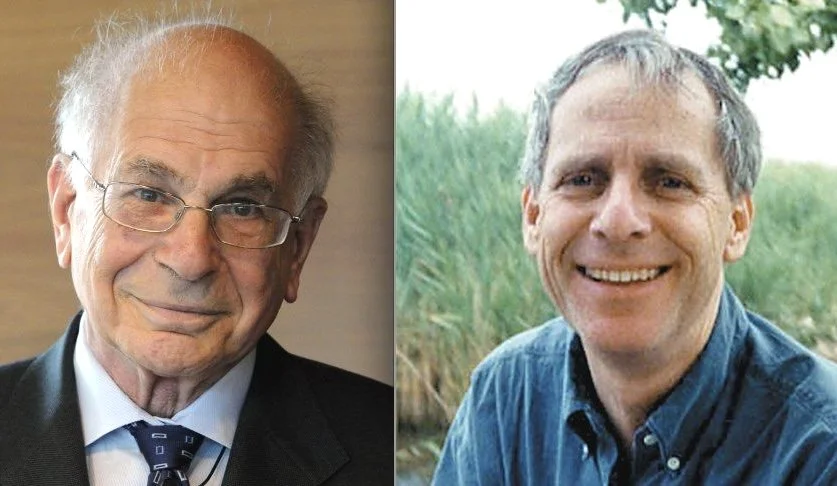
Daniel Kahneman (left) and Amos Tversky (right).
CLASS ACTIVITY I:
COGNITIVE BIAS SCENARIOS
Six scenarios have been carefully selected to provide students with a direct personal encounter with Kahneman and Tversky's findings.
Provide each student with a printed copy of the Questionnaire. Announce a timed five minutes for individual students to grapple with the scenarios and note their responses. Next, hand out copies of the Key for consolidation and conversation with a nearby partner.
Pdf. of the Questionnaire and the Key
Later, for a homework assignment, students should try them out on family members and at least one stranger.
—QUESTIONNAIRE—
SCENARIO #1
“Steve is very shy and withdrawn, invariably helpful, but with little interest in people, or in the world of reality. A meek and tidy soul, he has a need for order and structure and a passion for detail”
Is Steve more likely to be a librarian, or a farmer?
SCENARIO #2
“You have participated in a lottery at a fair, and have bought a single expensive ticket in the hope of winning the single large prize that is offered. The ticket was drawn blindly from a large urn and its number is 107358.”
When the result is announced the winning number was 107359. Do you think you would be more or less disappointed if the winning number was actually 207358.
SCENARIO #3
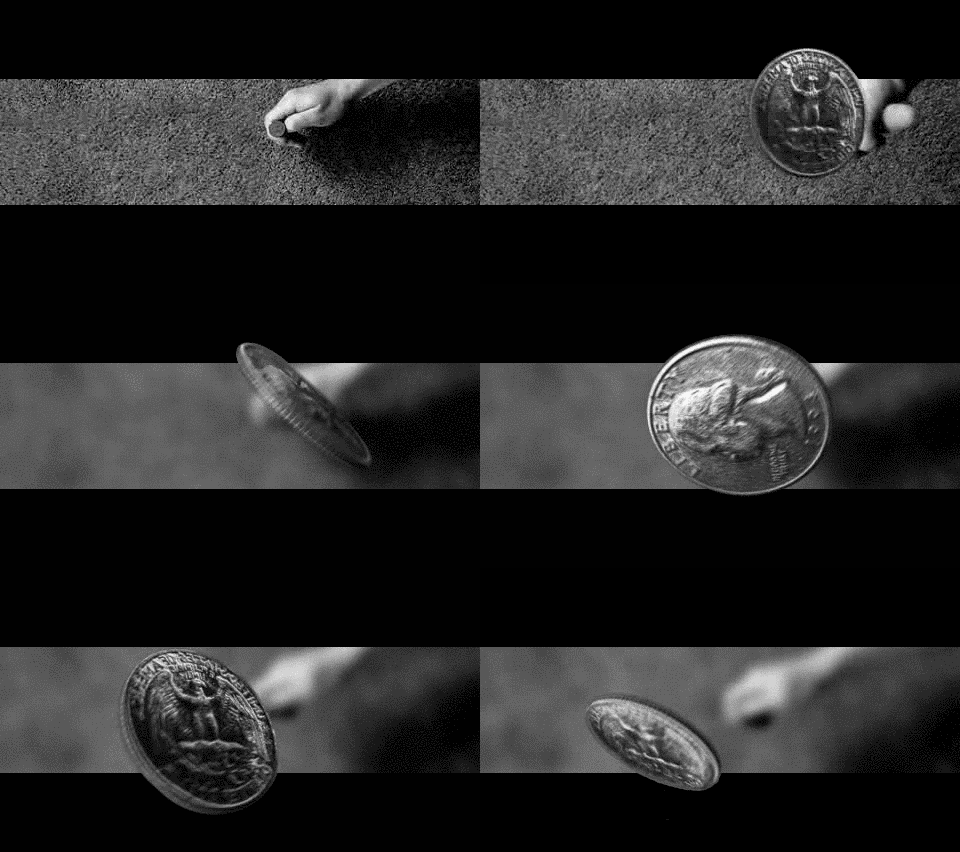
When repeatedly tossing a coin six times the first two sequences were:
“H-T-H-T-T-H and H-H-H-T-T-T.”
Which sequence was more likely?
SCENARIO #4
“In a discussion of flight training, experienced instructors noted that praise for an exceptionally smooth landing is typically followed by a poorer landing on the next try, while harsh criticism after a rough landing is usually followed by improvement on the next try.”
What conclusions would you make from this real data? Would your recommendation transfer to other training situations?
SCENARIO #5
Recall and write down the last two digits of your phone number.
Now estimate the “percentage of African countries in the United Nations.”
SCENARIO #6
Consider the following scenarios:
“A massive flood somewhere in North America next year, in which more than 1,000 people drown.”
“An earthquake in California sometime next year, causing a flood in which more than 1,000 people drown.”
Which of the two scenarios is more likely?
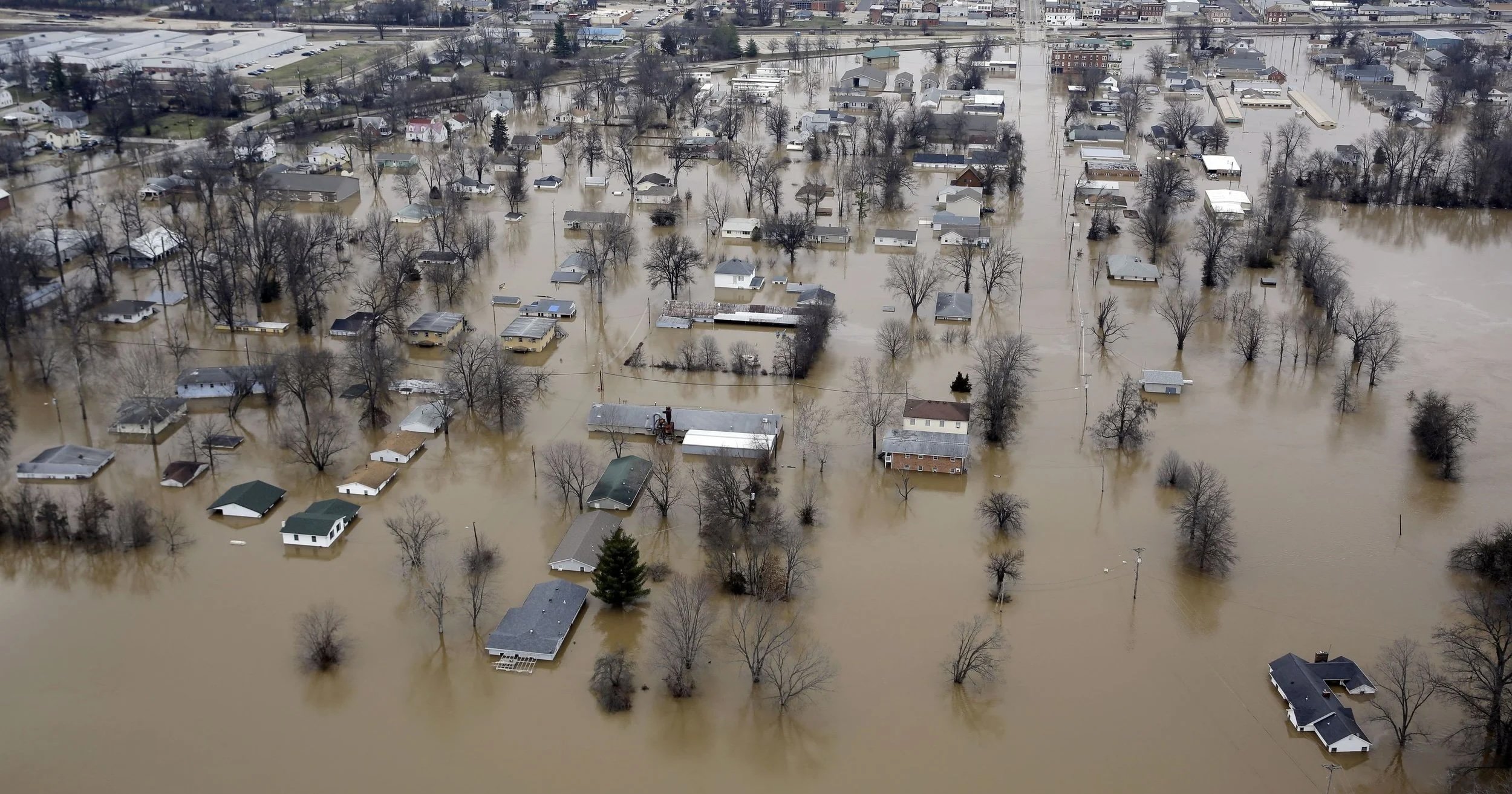
Rare winter flood in Missouri that prompted many evacuations.
Photo credit: Jeff Roberson, AP
—KEY—
SCENARIO #1
✅ Farmer
Representativeness
In the USA, there are roughly 20 male farmers for every one male librarian. Since the pool of farmers is so much larger, there are statistically many more "shy and tidy" farmers than there are "shy and tidy" librarians, even if a higher percentage of librarians fit that description.
The representativeness heuristic is a cognitive shortcut where people judge the probability of an event or the categorization of a person based on how closely they match a mental stereotype,
SCENARIO #2
✅ 107359
Near Miss Effect
Almost winning usually feels much worse than losing completely, despite the fact that the overall outcome is the same.
SCENARIO #3
⛔ Neither; both sequences were equally likely.
Gambler's fallacy
In a series of independent coin tosses, every specific sequence of heads (H) and tails (T) has the exact same probability. While the second sequence might look less random to our eyes, the coin has no memory and no preference for patterns.
SCENARIO #4
⛔ Criticism and praise may have minimal effect
Regression to the mean.
In any skill-based activity with a degree of randomness—like landing a plane—performance naturally fluctuates around an average. An "exceptionally smooth" landing is a statistical outlier; the next landing will likely be closer to the pilot's average (and thus appear "worse"). Conversely, a "rough" landing is also an outlier; the next attempt will likely be better simply because the pilot is returning to their baseline.
SCENARIO #5
⛔ Beware of rooting your answer on arbitrary initial input
Anchoring
There are 54 African member states in the United Nations. There are 193 total member states in the United Nations. Actual Percentage: 54 / 193 = approximately 28%.
SCENARIO #6
✅ The first scenario
Conjunction fallacy
Mathematically, the probability of two events occurring together (an earthquake and a flood) cannot be greater than the probability of one of those events occurring alone (just a flood).
Even though the second scenario provides a specific, vivid cause that might make it feel more "believable" or easier to imagine, it is a subset of the first.
The Conjunction heuristic is the trap of thinking that adding extra details to a scenario makes it appear more likely.
WHOLE CLASS DISCUSSION
This is a good time to mention Kahneman and Tvarsky’s formidable body of psychological research. Include the Kahnenmann quote below. Begin whole class discussion by asking students:
What just happened?
Were there any surprises?
Have you personally experienced situations and wrestled with conundrums like these?
GOING DEEPER
What do these scenarios reveal about the difference between probabilistic mathematical thinking and intuitive thinking?
What is “Thinking Fast” and “Thinking Slow”?
If you were able to try the scenarios on a family member or a stranger, what further insights did you gain?
To what extent do cognitive short cuts help or hinder knowing and thinking?
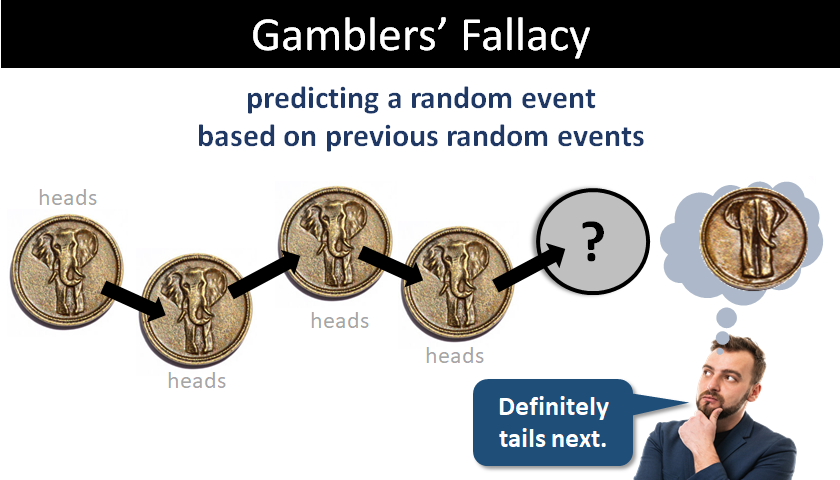
Have you ever fallen into this trap during a multiple-choice test?
“Disbelief is not an option. The results are not made up, nor are they statistical flukes. You have no choice but to accept that the major conclusions of the studies are true. More important, you must accept that they are true about you.”
CLASS ACTIVITY II:
COGNITIVE BIAS QUIZ
Direct students to complete the Cognitive Bias Lab Quiz online. There are 10 standardized questions. Encourage them to slow down and be honest about what they would teally do. The algorithm will generate individualized feedback.
24 COGNITIVE BIASES INTERACTIVE CHART

Broaden student self-awareness about unexamined cognitive biases one more notch by exploring the Your bias.is interactive chart. Students should click on each of the 24 icon gifs to reveal succinct encapsulations of the various cognitive short cuts.
An encyclopedic recall of cognitive biases is not the aim here. That said: students should not click through the chart too quickly. I recommend close readings of Sunk cost fallacy, Dunning-Kruger effect, Groupthink, Framing effect, Halo effect, Placebo effect and Bystander effect.
“Γνῶθι σεαυτόν
”Know thyself” ”
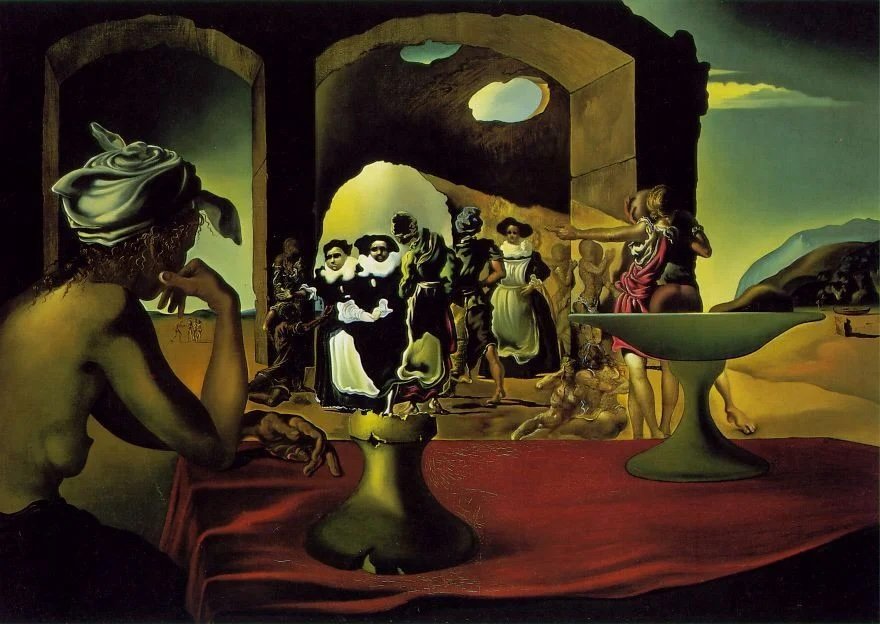
Salvador Dalí (1940) Slave Market with the Disappearing Bust of Voltaire. Oil on canvas. The Dali Museum, Tampa, FL